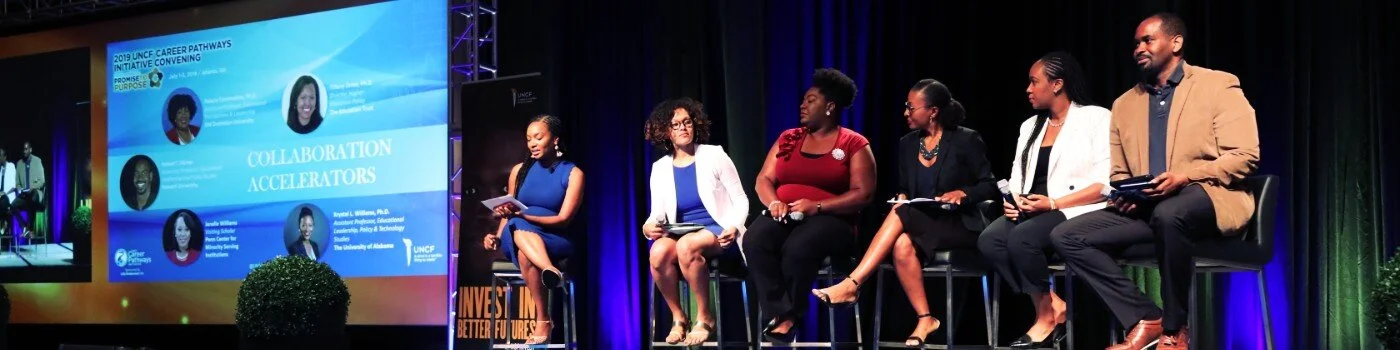
About LaToya Owens

LaToya Owens is a Charlotte native and proud graduate of Steele Creek Elementary School, Kennedy Middle School and Harding University High School, Doctor of Educational Research and Policy, and a public advocate committed to serving the Charlotte-Mecklenburg community.
As a senior leader at national educational philanthropies and nonprofit organizations in the higher education field, Dr. Owens has executed strategies aimed at increasing educational outcomes for students using evidence-based practices and evaluation frameworks. Her two-decade career has focused on implementing a multitude of educational interventions, including early education to higher education pathways, workforce development and preparation programs, and institutional effectiveness and transformation efforts aimed at increasing educational and economic outcomes.
Dr. Owens’ interest in serving on the CMS School Board was engendered by her own CMS journey, her current experience as a CMS parent and PTA leader, her national educational pipeline research and her community involvement. Dr. Owens has been a school leadership began in 2003 when she was a student body president at Harding University High School, and her developing understanding of the ability of education to level playing fields and increase overall life outcomes has driven her continued research, service and leadership. Her educational scholarship has primarily focused on the implementation of critical research, measurement and statistic practices to study the social foundations of education and non-traditional approaches to education, research and teaching. She has dedicated herself to advocating for and implementing transformational education policy and practices through collaboration with practitioners and use of liberatory and humanizing research methods.
As a CMS graduate who had positive experiences across the district and was well prepared for postsecondary pathways, she is motivated to ensure that every educational option is a good option, making school choice work for CMS parents. Dr. Owens has two elementary-aged children, Taj and Jari, and has been married for over a decade to Jerrad, a CMS teacher and coach. As a family, they are heavily involved in CMS programs and associated athletic leagues, dance centers, and other extracurricular programs throughout the Charlotte-Mecklenburg area.
Why CMS School Board?
As a student, I was the beneficiary of a myriad of supports that amplified my educational success. During my matriculation I also noticed many of the barriers in education that caused my peers to struggle through school and in reflection may have dampened some of my own spark and curiosity.
First, I was the beneficiary of involved parents with high expectations and a strong orientation towards education. My parents positioned education as a primary aspect in our lives and engendered a natural curiosity and a love of reading. I spent weekends completing extra math problems assigned by my mother, visiting public libraries to select babysitters club and sweet valley high novels. I also observed my parents as they battled, in some instances alongside dedicated practitioners, inequitable policies and practices to ensure I had access to resources and was continuously challenged. I came to understand the importance of parents having the tools to navigate the education system.
Second, I was blessed to experience teachers and administrators who deeply impacted my educational experience. In 7th grade, I took a pre-algebra class an early but masterful teacher, Shawn Jones. She was a dedicated teacher that went out of her way to help students, especially young women, navigate the complex social terrain of middle school while simultaneously ensuring we were successful in what we now know is a gateway course that ensured I had the necessary foundation for quantitative success throughout my matriculation including graduate education. Similarly, as a high school student, I experienced an AP biology teacher, Timothy Guilfoyle, who maintained my natural curiosity during a high-stakes period. His efforts to ensure exciting project-based learning, push students with high potential to struggle with complex concepts, and ensure a comfortable learning environment emanating from his own love of both science and teaching has sustained an interest in science into adulthood and helped me develop the study and organization skills necessary for college and workplace success.
Simultaneously, my high school principal, Dr. Curtis Carroll, who I now know to be an educational expert, maintained an environment of high academic and behavioral expectations, mutual respect and wrap-around care. Mr. Carroll knew his students deeply and I am the beneficiary of hand-picked opportunities that propelled my personal development. More than anything, each one of these teachers offered, at some point, personalized care that helped develop trust. The culmination of these experiences illuminated the necessity of skilled and dedicated teachers and administrators steeped in pedagogy and experience.
Third, I benefited from multiple models of education that fulfilled my needs at different points in my educational journey. I went to both traditional neighborhood schools and a specialized magnet high school. While my neighborhood schools supported a foundation that was steeped in community and care, my magnet high school allowed for early specialization to move further with particular areas of interest and experience rigorous college preparation alongside peers with similar interests. Later, my brother and sister would also need different high school models, including a traditional neighborhood high school and a choice health sciences academy program, to support their own needs at that phase. Here I came to understand the importance of differentiation and choice in schooling to meet student needs and interests.
Thus, my why is simple. I want to ensure students, including my own children and their peers, have AT MINIMUM what I had in school: parents with the tools to help them navigate, master teachers and administration with the space to focus on sound pedagogical practices, a multitude of good school/program options to meet student needs. Taken together, I want communities, including parents, students and teachers, to be at the forefront of decision-making.